




I'm becoming increasingly aware that my neurodivergent ways of doing things might be a good reason why I'm not so easily replaceable by AI. Unfortunately, reasoning in a fundamentally different manner than the stochastic parrots is not something that I can simply include in my CV. I am also conscious that a vibe-based approach to things, as dirty as the connotations to the word have become today, does not necessarily foster the most consistent of practices.
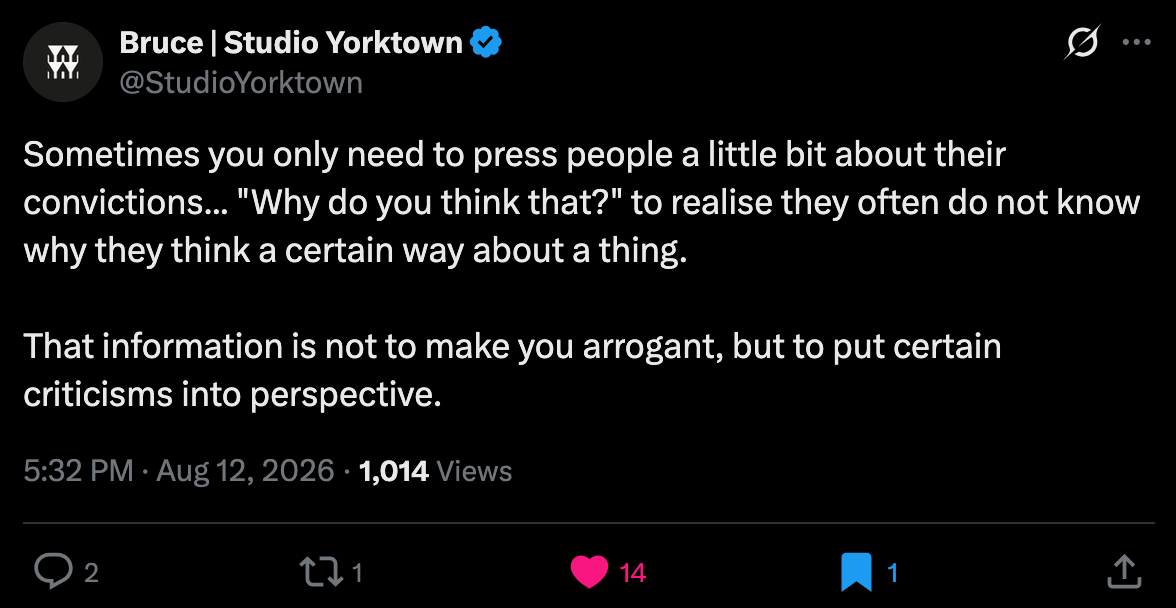
I recently saw this post by Bruce over on X, who you might better know as the creative mind behind Studio Yorktown, and felt personally called out:
 (opens in a new tab)
Bruce is an artist that I hold in high regard for his meticulous and discerning approach to creative work. From the projects I've seen him publish over the years, I have the impression that he is very structured and organised about everything that he does, not leaving much up to chance. Judging my own approach, I find that it sits at the other end of the spectrum.
His post calls out something important that I don't do nearly enough—not with other people per se—but as a personal exercise where I put myself in the interrogation chair. Which I think is arguably much more difficult.
And for a lot of personal creative work you can get away with a loose approach. While you will end up acquiring a sort of innate sense of "taste" and an abstract understanding for the "why"s, it's not a very tangible thing that can be easily described. If I had to put it into words, it's almost like a Marie Kondo-esque method (the KonMari Method™ (opens in a new tab)) for evaluating things based on the joy that they bring me. If I had to reason about every single step along the way, rather than following my desire to "see what could be", I would most likely be inhibited in my making of things.
And it occurs to me that this might just be the reason why I've personally struggled working with agents in a creative setting, where you already need to have a hunch for what you want to achieve and then provide guidance and instructions to get there. This doesn't really mimic the process that I experience internally. That's not to say that I haven't found some agentic approaches that have been effective for me in the past months.
And suddenly, this abstract sense of taste that I've somehow cultivated by doing, making, and simply existing over the years, that I can often hardly put into words for myself, let alone for others, is supposedly the last thing that still sets me apart from the intelligent machines. As the media claims, at least. Here I'm not sure if clinging on to a fleeting feeling, an ephemeral spark that on occasion makes me "produce" things, is supposed to be a comforting thought.
How can I encode something that I can’t really put into words? For most of the past year I've been really trying to understand what truth there is to this idea, and what we're actually trying to get at with the entire discussion around taste in the setting of AI:
- What do the media and the AI industry claim taste to be in 2026? What is taste really, out there in the real world? And how do we reconcile the two?
- In what way, shape, or form can LLMs and agents actually acquire taste? Surely skill files can't be the final frontier?
Taste, past the Hype
In the 1996 documentary Triumph of the Nerds (opens in a new tab), there's an iconic scene where Steve Jobs talks about taste. When asked about Microsoft's success, after they had captured most of the PC market at the time, he tears into the rival by using taste as a distinguishing standard between their endeavours and products:
The only problem with Microsoft is, they just have no taste. They have absolutely no taste [...] and I don't mean that in a small way, I mean that in a big way in a sense that they don't think of original ideas and they don't bring much culture into their product.
Almost like a weapon, Jobs uses taste as a means to defend Apple's superiority over the competition, even when the competition was actually winning. Polarising as he was, Jobs genuinely believed that Microsoft’s lack of originality and cultural awareness gave Apple an invisible edge. In the same interview he even goes as far as labelling Microsoft the "McDonald's" of tech. While many dismissed this as sour grapes back then, Jobs eventually proved that taste-driven design was critical to building breakout products; in the early 2000s Apple's sleek, user-centric hardware ended up sparking one of the greatest comebacks in tech history (opens in a new tab).
I think that he struck on something very important by relating taste to culture and anchoring his products in meaning and aesthetics that were derived from shared human values. When you strip that away—whether in '90s software or modern generative tools—you are left with output that is purely functional and generic, that optimises for the lowest common denominator, and is built to satisfy a checklist rather than resonate with people. It becomes generic and hollow.
Just like a lot of what is LLM-produced today feels like fast food, you could argue that the manner in which he used taste as a narrative selling point is not too dissimilar from how the AI industry uses it as a modern marketing vehicle. In both cases, taste is a means for establishing legitimacy and signal competitive advantage.
Over the past year we've seen a resurgence of attempts to define and re-define what "taste" means in this new era, and in the process become a ubiquitous buzz-word that now finds its way into all AI related discourse. Going through a big chunk of what's being said and written today, I get a sense that there are quite a few conflations and misconceptions when the term is used, most commonly as a proxy for closely related but generally different notions.
An article that I believe to really cut through the noise, is Celine Nguyen's text Why We Like Things (opens in a new tab) for Asterisk Magazine. Nguyen also shows that historically framing taste as an economic advantage isn't new and can be traced back to earlier waves of automation. Against that backdrop, she critiques how the term is currently being bent to fit a narrow, self-serving tech narrative:
[...] those who invoke taste often fail to explain what it is. And curiously, although many in Silicon Valley are bullish on AI’s potential to write novels, solve mathematical proofs, and generate feature-length films — to create outputs, in other words, that combine taste and technique — they seem convinced that taste itself is not replaceable.
And it really doesn't make much sense: if these models are all-capable and solve all of our problems, why don't they also have the capacity to have taste? Why is that where we draw the line?
That's because it simply is a contradiction. This is where taste becomes a means of subversion and treated as a snake-oil-like quality that's bent to fit different buckets and justify a narrative. Others have pointed this out as well, Kyle Chayka's New Yorker column Why tech bros are obsessed with "taste" (opens in a new tab) puts it quite succinctly by labelling it as "taste-washing":
A.I. companies need to associate themselves with taste precisely because their tools are not very palatable, much less cool, to anyone outside of Silicon Valley. Many people view A.I. tools as a threat—to their livelihoods, to their futures, to their senses of self. Few, whom I know, see them as individuality-affirming life-style choices. We might call what’s going on now “taste-washing,” an attempt to give anti-humanist technologies a veneer of liberal humanism.
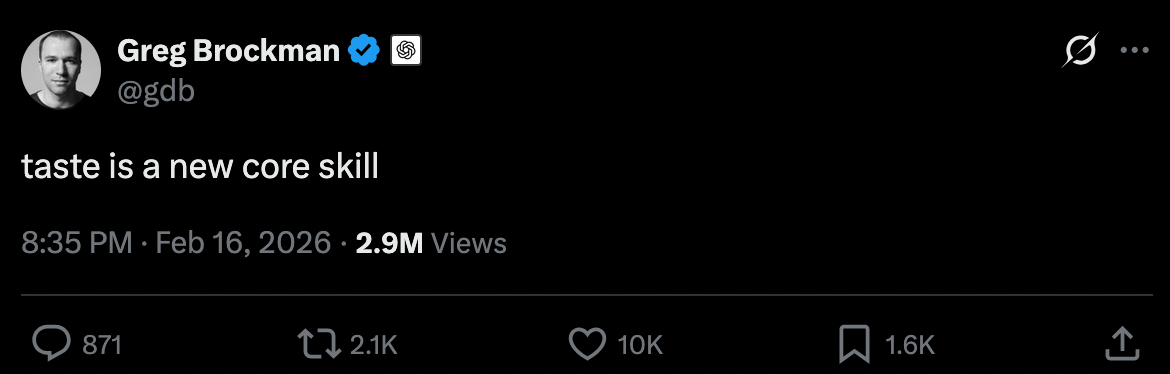
Maybe it isn't always intentional. A lot of it is probably just people repeating a word that sounds good. But either way, this is mostly how taste is being abused by the AI industry right now, and I think recognising this pattern is core to discerning whether the word is used appropriately or inappropriately in a given context. Once you strip away the marketing spin, you realise how little actual substance is left behind.
 (opens in a new tab)
So what actually is taste, past the hype, in the real world? A few writers that have come quite close to a meaningful definition in my opinion are the following:
- Jack Cheng's What is taste, really? (opens in a new tab) sits at the top of the search results when you Google for taste and AI. He describes it as an acquired means of discernment that reflects our aggregate self and lets us interact with and judge the culture around us.
- Tim Sullivan's Beyond slop, taste, and AI moral panic: What social science tells us (opens in a new tab) talks about the different modalities of taste. He argues it's a broader folk category into which we're collapsing many different mechanisms, including social, cultural, and human factors. A section that I thought is really important is where he talks about taste emerging from crossing social boundaries:
"The people who seem to have an uncanny feel for what’s interesting, original, or promising are often those who spend their lives moving between otherwise disconnected social worlds. Their “taste” emerges not from mysterious intuition but from repeated exposure to combinations that no one else is able to see." - In her notes on technological anxiety (opens in a new tab), Emily Segal opens up a different vertical by addressing the rise of tasteslop. Tasteslop is, in essence, a new phenomenon where mass-produced content is masqueraded as being tasteful when it doesn't really understand itself. For her definition though, she echoes both Cheng and Sullivan, adding to it the notion of human idiosyncrasy, and that much of our taste is contextual and automatically esoteric.
"Personal relevance is the type of thing that makes taste meaningful, contextual, and automatically somewhat esoteric [...] I would say the biggest thing people are missing about taste across the board is that it is relative, contextual, and social. Taste needs to be socially validated. There is no such thing as taste if it falls in a forest."
Put side by side, the three agree that taste comes from culture. For Cheng, it's acquired through experience, and it only becomes discernment once you can say why. Sullivan shows that moving between social worlds, and seeing unique combinations is where we build this taste. Segal adds that it's personal and contextual, and that it only counts once other people recognise it.
Pulling those together, taste becomes a subjective and justifiable sense of what we like and dislike, that's acquired through the culture around us and the people that we share it with. If the marketing tastefully led with this definition and reasoning, then the claim that taste can't be replaced would actually hold up, and we could come to the agreement that LLMs, in their current capacity at least, probably aren't capable of replacing our taste-based judgments.
But to comment on this, we also need to have a look at some arguments why models do not have an understanding of taste, after all models have been exposed to more culture than any single of us, and how we are currently steering LLMs towards tasteful outputs.
Taste in LLMs is just a game of Offsetting the Average
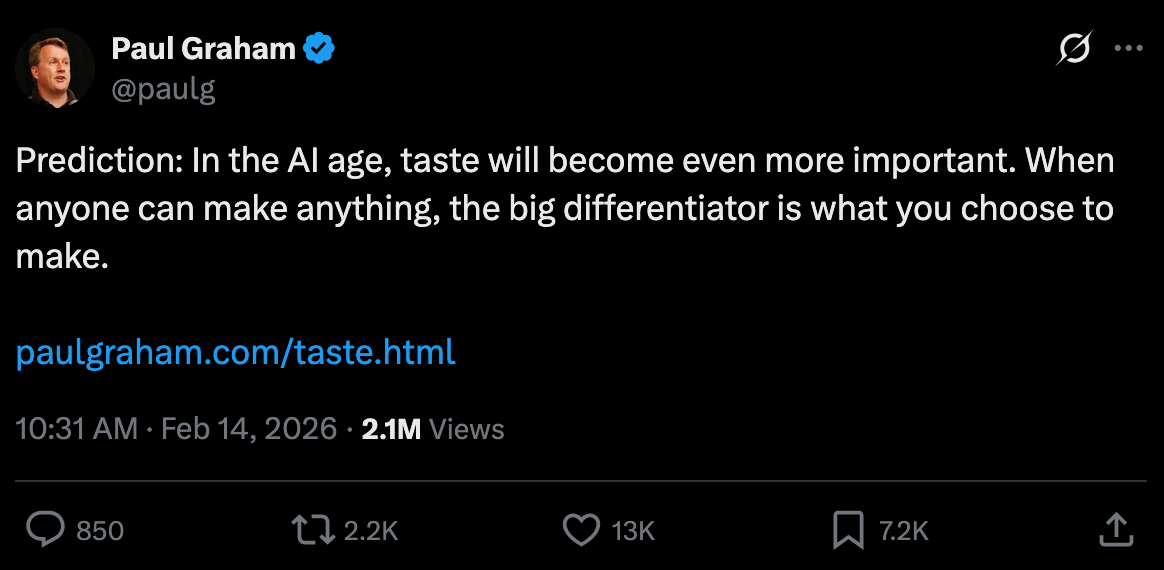
Paul Graham's 2002 article "Taste for Makers" is basically the OG "skill file" for humans. It's a manifesto of 14 design principles that try to define what makes for objectively good taste, and acts as a spine for the overarching argument that taste is something that can be put into words and studied. Rules like: Good Design is Simple, Good Design is Timeless, Good Design is Suggestive, and so on. Over the years it became a highly influential text for its contrarian point of view, and makes it situated at the root of today's discourse concerning taste and AI.
If it is true that taste is objective and document-able, as a set of rules and descriptors, then surely it can be instilled into our probabilistic text predictors.
Graham did receive his fair share of criticism though, especially for the seemingly circular reasoning that occurs throughout the principles he sets up. Back in 2006, David Weinberger pointed out the main problem (opens in a new tab) during an interview, stating that a rule like "good design is simple" can't tell you which parts are extraneous. You would already need taste in the first place to apply it, and in turn, this would mean that following a recipe doesn't automatically make your work tasteful.
Fast forward to today, where lists of rules are currently the main way that we are instilling taste into LLMs. These kinds of lists are now better known as skills, a format Anthropic introduced (opens in a new tab) roughly a year ago and later released as an open standard, that most AI programming tools like Codex, Cursor and GitHub Copilot now also support.
In a nutshell, a skill is just a folder with a markdown file called SKILL.md in it. At the top sits a short name and a description of when the skill should be used. Then only when the agent sees a task that matches this description does it load in the rest into its context. That then encompasses actual instructions, sometimes with scripts, reference material and templates attached.
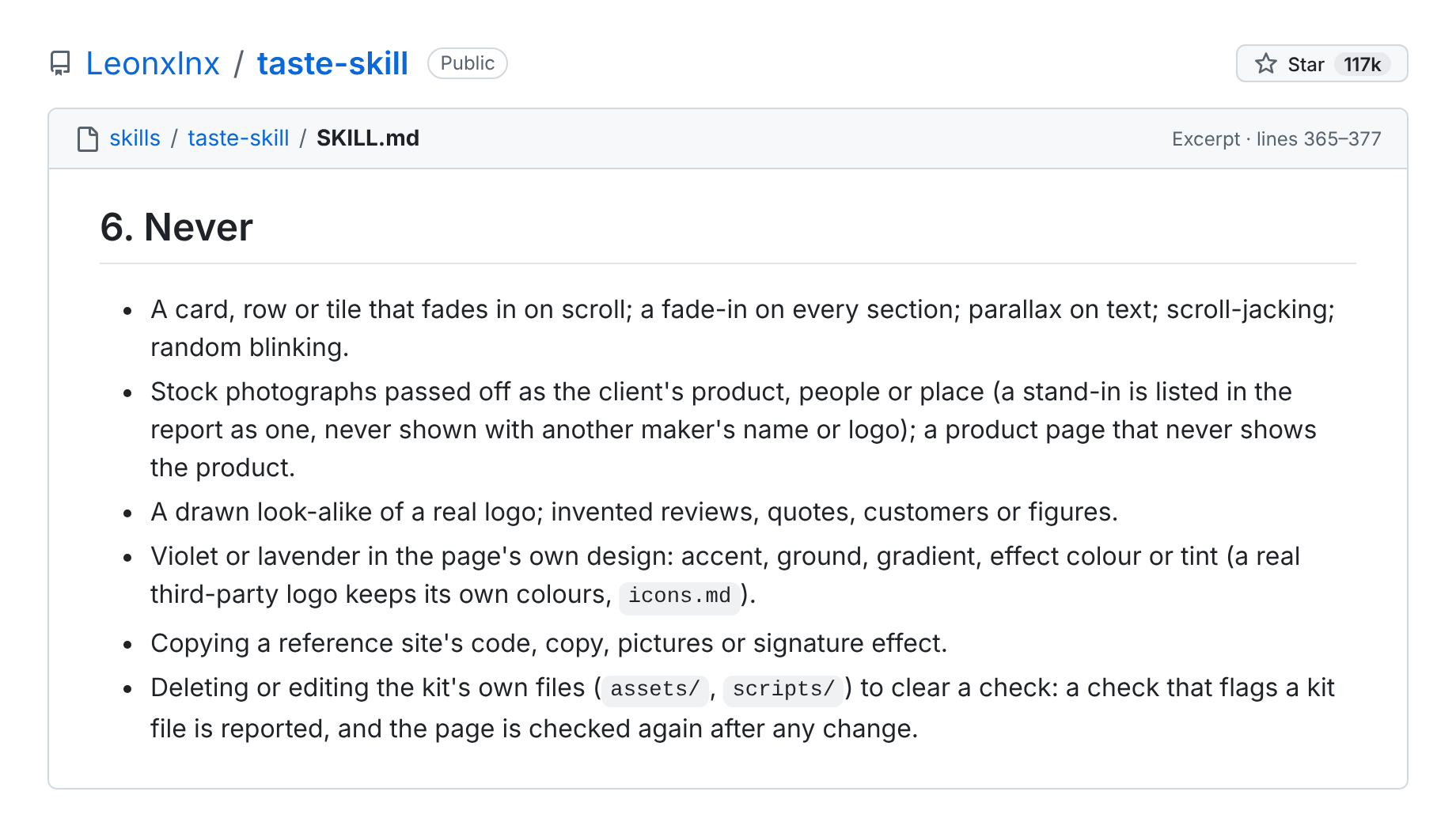
While skill files haven't been solely devised for the purpose of making LLMs produce tasteful outputs, a good chunk of them are aimed to be a solution for it. There are now numerous extremely popular github repositories (measured by number of stars) that claim to be taste skills. Here's some examples:
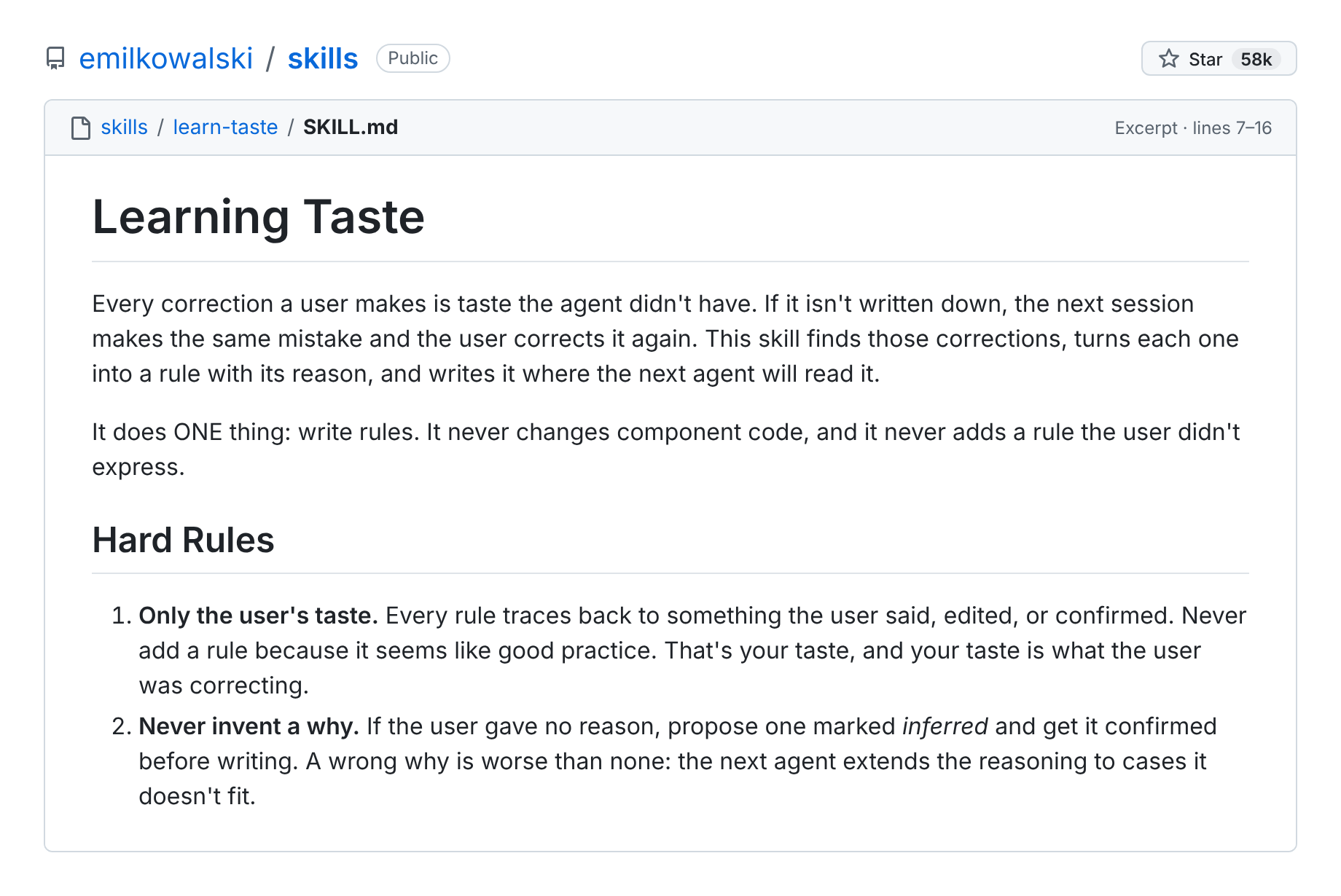
Link to Leonxlnx's repo (opens in a new tab) | Link to Emil Kowalski's repo (opens in a new tab)
For instance, the titular Taste Skill (opens in a new tab) by leonxlnx, that currently is the most-starred skill with "taste" in its name. Zooming in some parts of it, its "Never" list describes what the average AI-generated page looks like, from fade-ins on scroll, rounded element borders, to anything that's coloured in violet, and bans all of it. It instructs the LLM to stray away from the generic output that it would otherwise most commonly conjure.
But what is it supposed to produce instead? Who knows, but it will likely draw from somewhere else in the model's latent space.
Another one is Emil Kowalski's learn-taste skill (opens in a new tab) that works the other way around. It goes back through your sessions, collects the corrections you've made, and turns them into rules for the next agent to read and apply. I'm not certain if this is actually more elaborate or maybe worse for having the agent emulate your judgements; on the one hand, it will pick up on your decisions and know what to do when it runs into a similar scenario, but on the other hand, it might not have the required context to act on slight variations of similar problems.
Structurally, these approaches are just Graham's Taste for Makers in a format that agents understand. Although, you could probably even load in Graham's original Taste for Makers and hope for the best. I'm not arguing that it's not an effective way to steer agents towards meaningful outputs, but it runs into the same problem that I already pointed out earlier and that Weinberger had stated in the past. The file can instruct the model to follow certain principles, do certain things, and reason in a specific manner, but making decisions around all of this still needs to be informed by context.
You could argue that by virtue of being trained on an enormous number of human judgments and opinions, and very likely continuously improved through our day-to-day interactions with them, LLMs are big taste aggregates. Just not of one single self. Whenever they're used to produce work, what comes out is a kind of averaged taste, a taste of nobody in particular.
And here I want to be careful with what I'm claiming, because things are changing rapidly and maybe by the time I publish this we already have new information, such as one of the leading AI labs revealing a new sort of model or method, that flips all of these arguments upside down.
And just so that I'm not pulling things from thin air, a NeurIPS 2025 best paper actually investigated this, finding that different and unrelated models echo each other, and converge on the same answers. Looking at how they responded to 26,000 open-ended prompts, all of them tend to regurgitate the same ideas. In their headline example for instance, they asked 25 different models to "write a metaphor about time," 50 times each. Most of the 1,250 answers were some version of "time is a river," with "time is a weaver" a distant second.
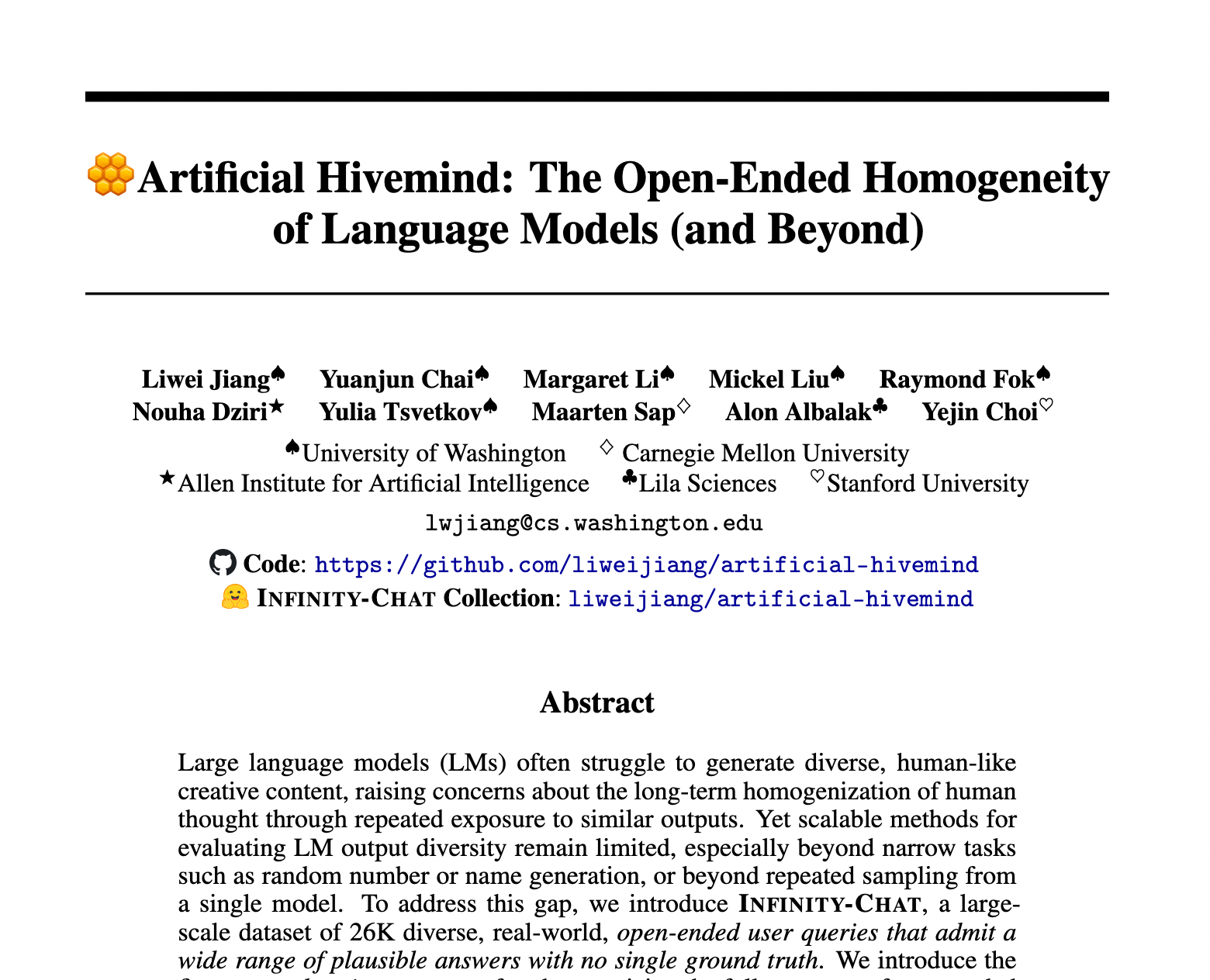
Then they also had 25 people rate each answer, to see where humans genuinely disagree, and that's where AI's judgement did worst. On answers of similar quality that people liked for different, personal reasons, the reward models matched the human ratings poorly. In other words, they're least reliable exactly where taste comes in.
So, to me, all efforts of instilling taste into models just end up being attempts at offsetting the average. We're not really giving models an understanding or the ability to understand what taste means in the real world. It's essentially this game you end up playing with the LLM to arrive at something interesting and tasteful, but the novelty is definitely not intrinsically coming from the model itself.
There are other useful methods out there as well of course, such as what Sari Azout's text What matters in the age of AI is taste (opens in a new tab) describes as context curation. (Despite her argument again trivialising what taste means to humans). Other methods I'd be careful of labelling as proper techniques because they're borderline heuristic in nature (how I feel about most methods for steering agents and LLMs at this point in time). For instance, a hack that went viral this year, that you might have seen, was a sort of taste interview. You essentially ask the LLM to interview you about your preferences and then have those choices injected into the context before it goes back to work. But this also just falls under context curation in my opinion.
Ultimately, the question is not whether or not models can understand taste — because they simply can't the way we own taste in the real world — (human-written em-dash btw) it makes much more sense to think in terms of how we're steering models to produce outputs that carry our own judgements and opinions. And I believe that this is actually a very positive realisation at this point in time. As we grow more discerning and aware of what is and isn't lazily AI generated, concerning the methodology, as well as the final resulting work, we can become more comfortable with models being an integral part of our processes.
Right now though, I have a sense that most methodologies are still very hype-based, unmeasurable and heuristic in nature.
Back in the Interrogation Chair
After going through all of this to understand what the AI industry means with taste, what taste actually is, and how we're currently feeding it into LLMs, I believe we're left with a few main take-aways here:
- The meaning of taste, as an overhyped buzz-word, is currently heavily contorted. In most cases it's just parroted because it sounds good. Just like Bruce's post tells us to press people on their convictions, as a good way to test them on their reasoning, the next time you hear someone use taste, press them on it and ask what they actually mean with it.
- Taste is rooted in culture and in our experiences. Being personal, contextual, and circumstantially esoteric makes it hard to put into words.
- Instilling taste into LLMs is a game of offsetting the average. LLMs have a vague, conditional, and averaged internal representation of what taste means, it is entirely up to us to steer them towards interesting and novel outputs. This might not stay true for long. But for the moment at least, models are not able to have the culturally cultivated kind of taste that we do as humans.
There are many other interesting threads to pull from these discussions, that find themself in a completely different limelight now that AI enables makers to create things beyond their initial capabilities. But those ideas will have to wait for another time.
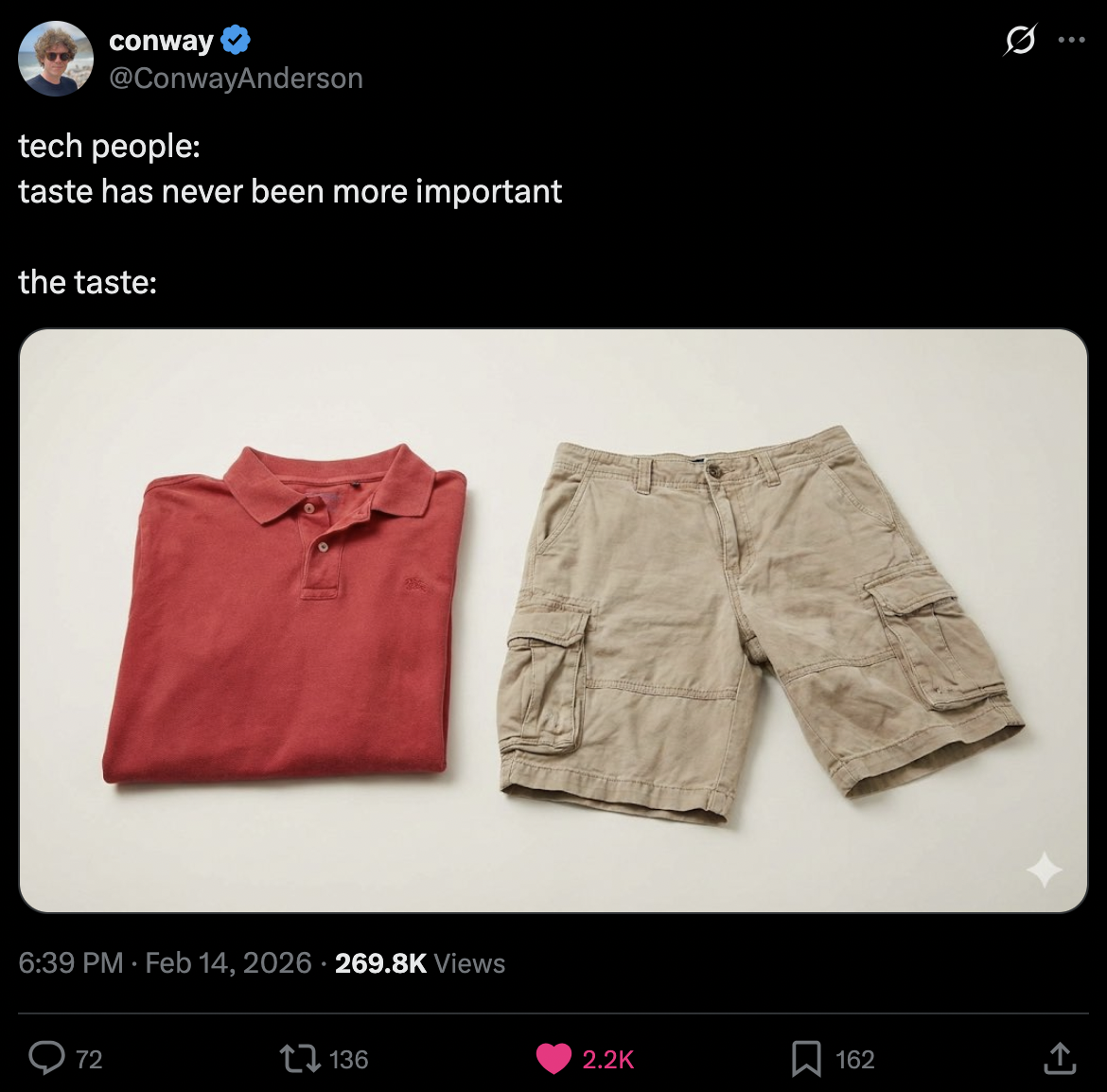
To conclude, I want to make a call-back to Celine Nguyen's article, she ends her text with the following statement:
Our tastes are how we understand ourselves — and communicating them is how we understand each other.
And I think, for me personally, that means that I still have some work to do, in cultivating my ability to reason about my own ways and communicating my preferences to others. The more we understand how our brains operate on a nuanced level, the more we can distinguish ourselves from AI reasoning loops, and that hopefully taste might actually be the final moat between us and our machine counterparts.