



Hi everyone 👋 I'm back! It's been a minute since I last published a newsletter — almost a year now! And a lot's happened in the meantime, if you're curious where I've been, I published an update here.
 Ahmad Moussa
If you're just back for the news, then keep scrolling! 👇
This is the 102nd issue of the Gorilla Newsletter — aweekly(let's see if we can make it weekly again) online publication that sums up everything noteworthy in creative tech, and AI.
If it's your first time here, we've also got a Discord server where we nerd out about all sorts of genart and tech things — if you want to connect with other readers of the newsletter, come and say hi: Here's an invite link!
That said, cue the news! ✨
New in Creative Tech
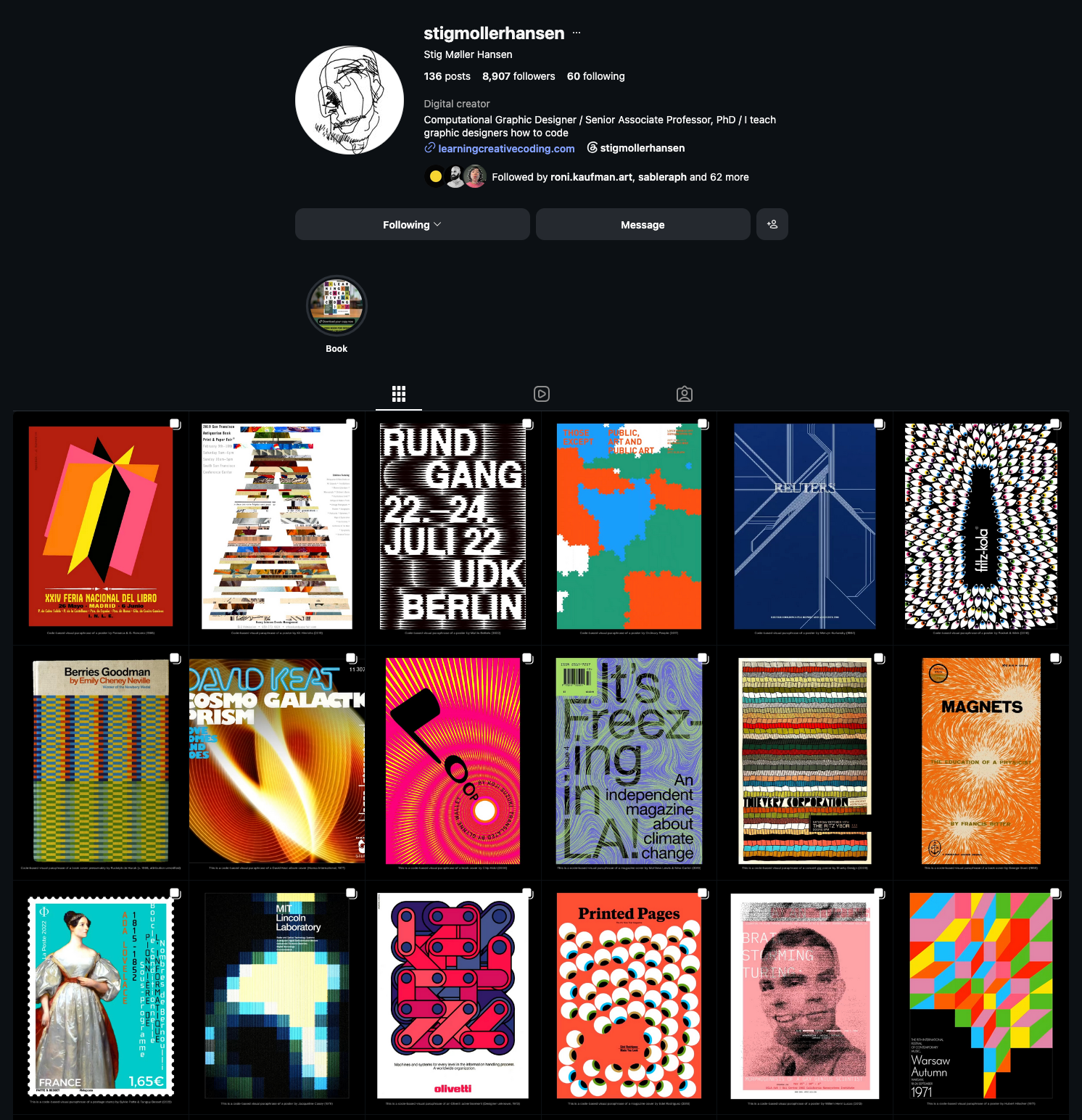
It's truly a treasure-trove of inspiration that I recommend exploring for yourself. Each recreation is accompanied by a short description that provides additional historical context around the original inspiration. I believe that Stig's intent behind each recreation is in most cases the idea of bringing to life a static design via parametrization, allowing Stig to not just recreate the original but also generate different varieties of the same design at once.
While that's already an impressive body of work, Stig gets the top spot of this issue for the book he published earlier this year: Learning Creative Coding.
 Pau
Pau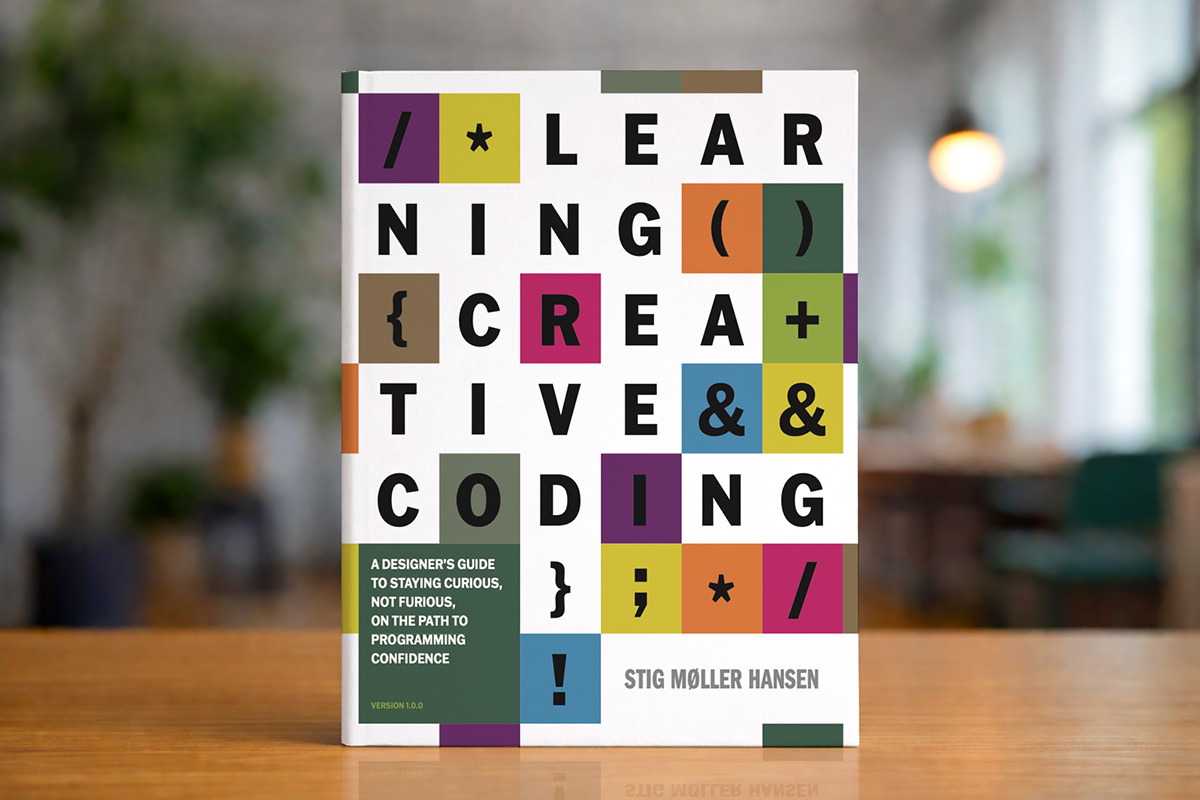
I believe the title of the book to be self-explanatory, but after reading a few chapters and skimming the rest, even if you're already experienced, it's not something to be glossed over.
It's not really a technical book, far from it, it's about the process, the mindset, and many of the psychological aspects of creative coding, programming art, and design programming in general. And Stig hits some of the most important topics that it involves.
This book won’t teach you syntax. It won’t walk you through tutorials. It won’t make the learning easy. What it will do is help you understand what you’re experiencing and why it matters.
I'm not fully through it yet, but I genuinely can't express how much I appreciate that the book simply starts out with the topic of frustration in creative work. It really struck a chord with me. A lot of careers probably come with their own frustrations, but I think it's a special kind when it comes to creative work. What's more is that the chapters are also color-coded with a virtue system — meaning that you can read the chapters in a different order, depending on what kind of struggle you are currently dealing with.
 Golan Levin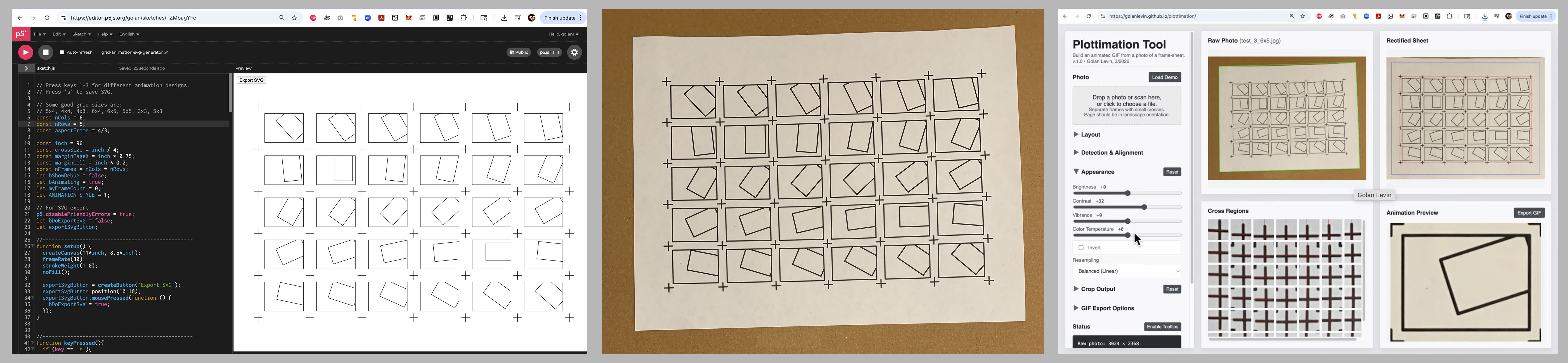
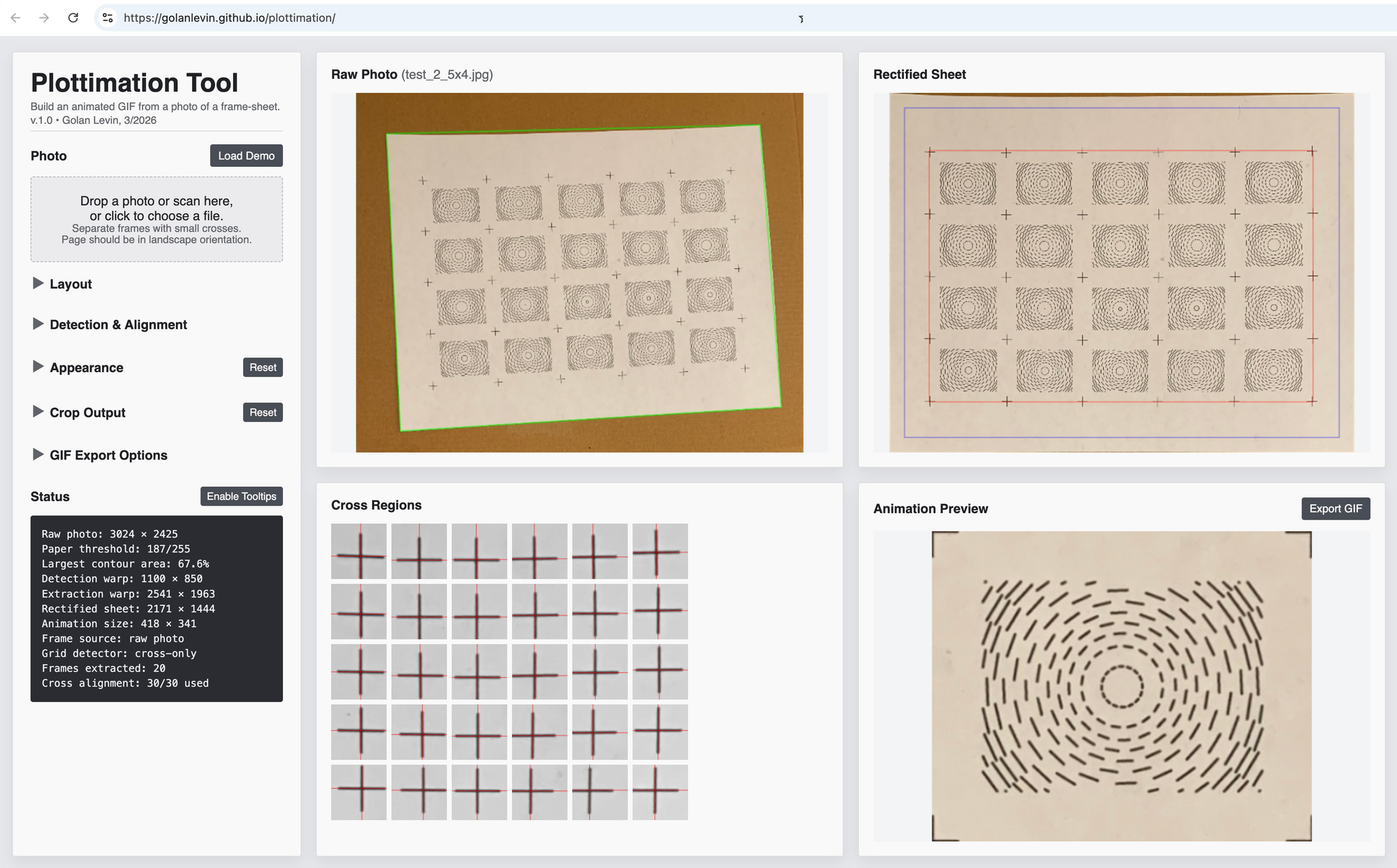
Golan provides a quick demo video over on YouTube that explains how the website works, but essentially you simply need to upload a photo of the sheet:
As someone that's tried to create a plotted animation from simply taking individual photographs of each frame, let me tell you how pain staking it is to do so manually.
I've mentioned it before, but the biggest hurdle to shader programming is that it requires you to fundamentally think differently about your code. You're now writing code that runs in parallel for each pixel, without the ability to share state between them so easily. Often a crutch I use in my regular sketching.
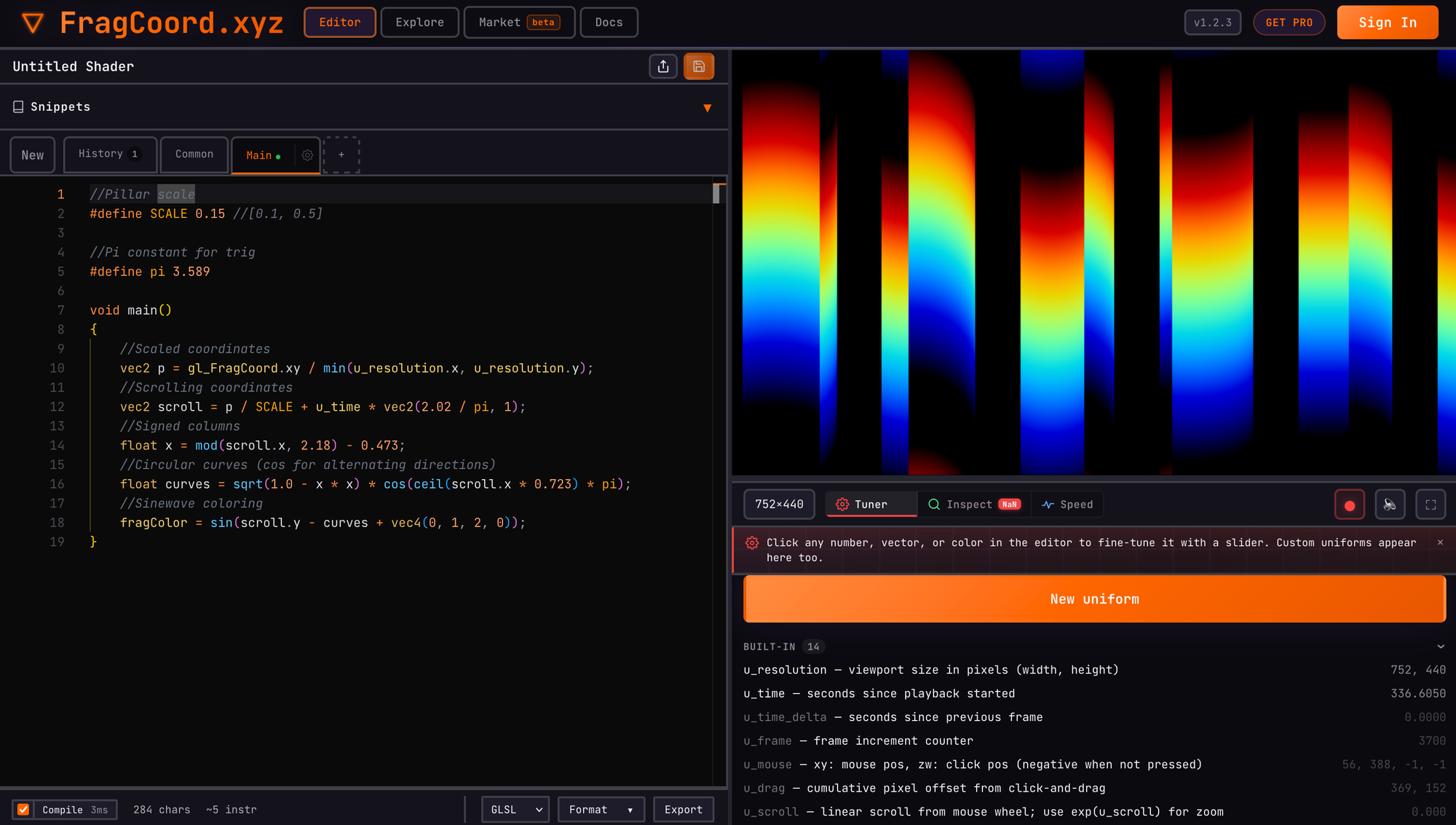
In the docs it mentions that it's inspired by the other online shader editors like ShaderToy, TwiGL, etc. now I do have to say that I like the fragcoord layout a bit more than the others, it seems to offer more features to play with code and inspect the shader code.
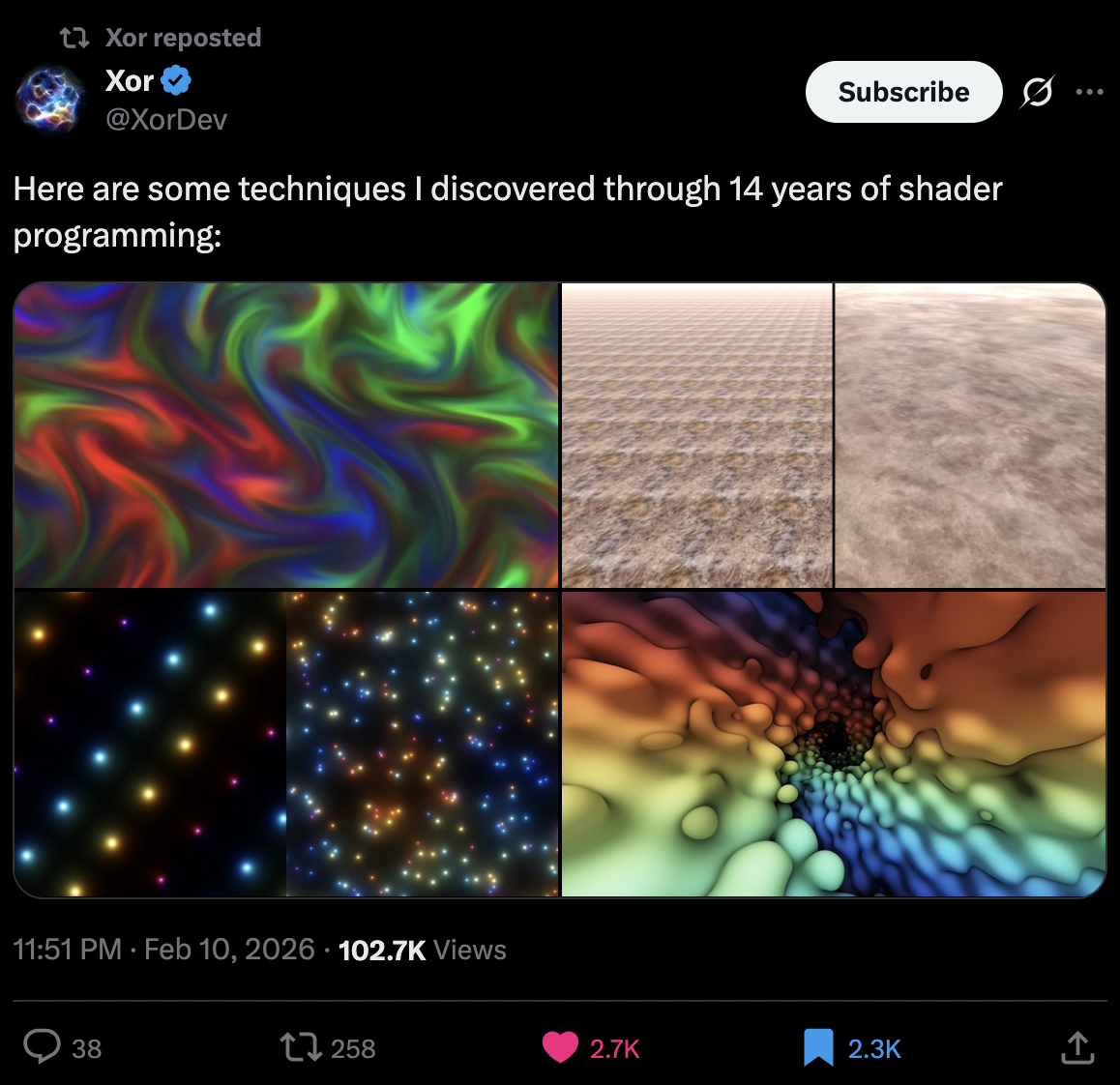
I also came across a thread of XOR's where he recounts some of his favourite tricks that he's discovered over the course of 14 years of shader programming:
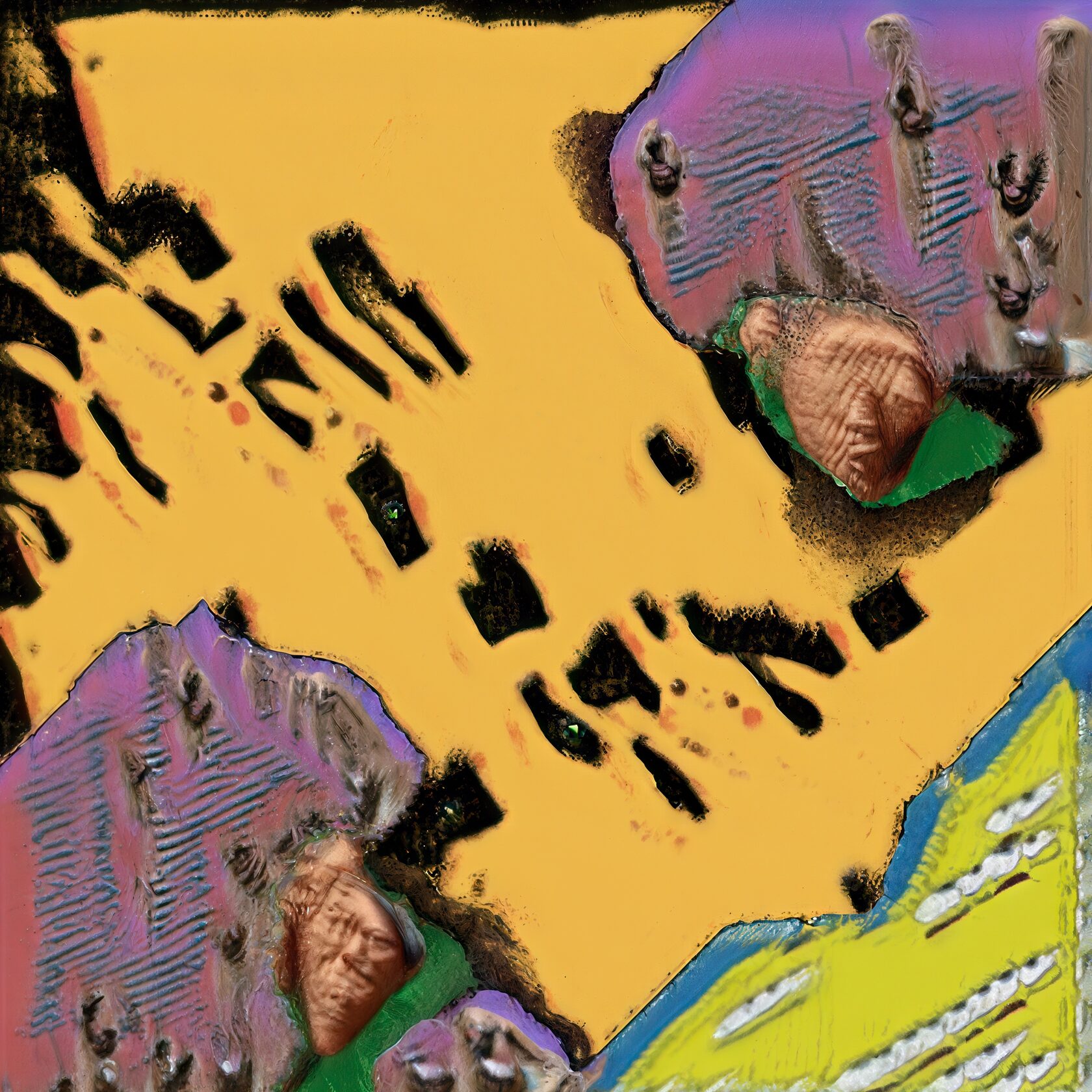
Luba Elliott also interviewed some of the participating artists for a feature article on LeRandom — highly recommend checking that post out.
2026's theme was loosely organized around "more-than-human" — the idea that intelligence and agency exist not just in people but in the systems, environments, and entities around us. The framing text they shared was Zoë Sofia's 2000 essay "Container Technologies," which argues for valuing sustenance, maintenance, and care over extraction and control. You can read about all 7 artists and watch their project presentations over on the rhizome website.
The Recognition of Faces investigates the minimum amount of visual information required for humans to recognize a face. He reduced a photograph to roughly 200 coarse squares using only 16 shades of gray — essentially an extreme low-resolution pixelation — and found that people could still identify it as a human face, and whose human face it actually was. The work probed how the brain fills in gaps and reconstructs coherent perception from sparse, degraded input.
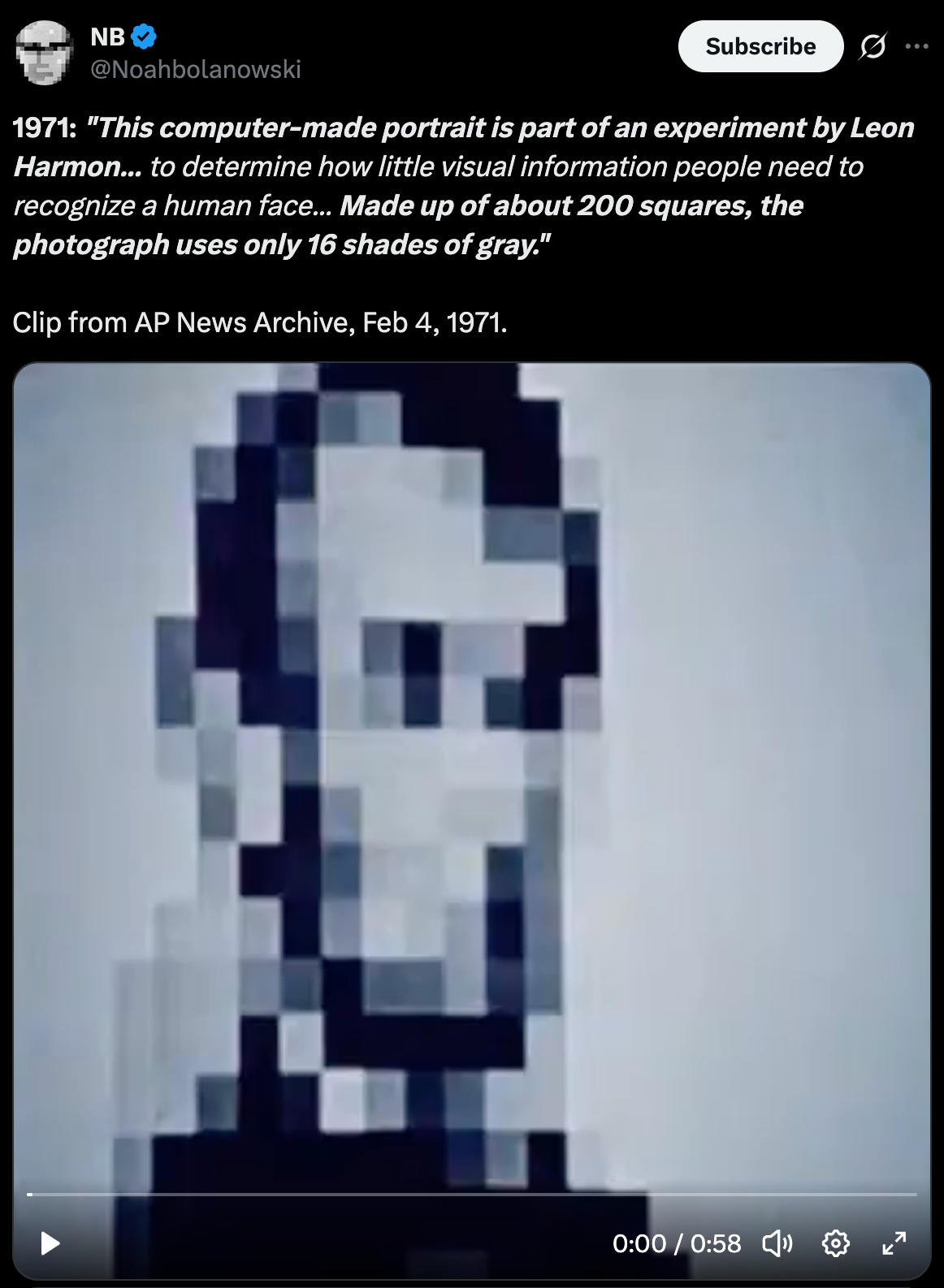
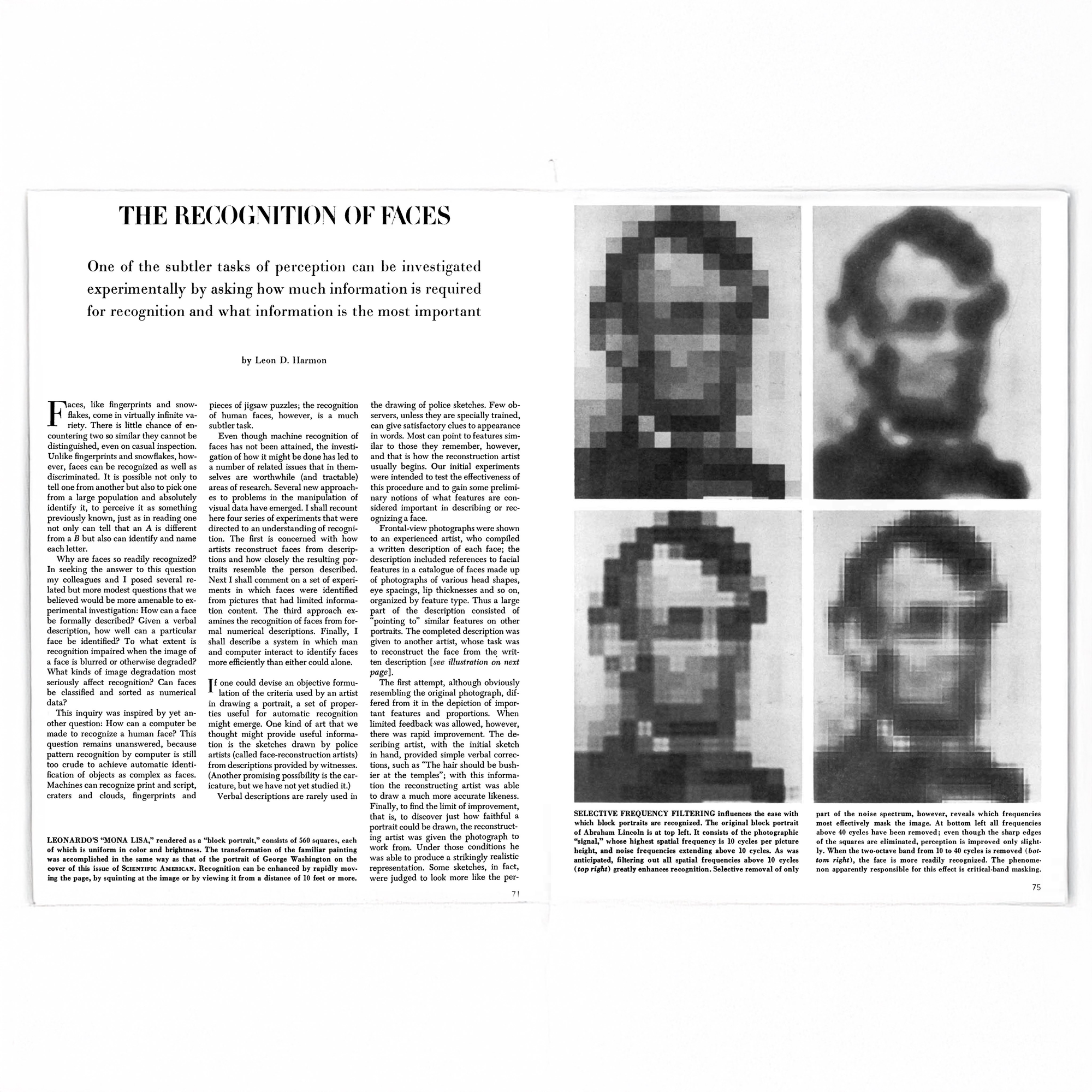
It's an early landmark in visual perception research, and also a precursor to ideas that would later become central to digital image compression and, much further down the line, to how neural networks "see." You can read the full 1973 text "The Recognition of Faces" here.
Tech & Web Dev
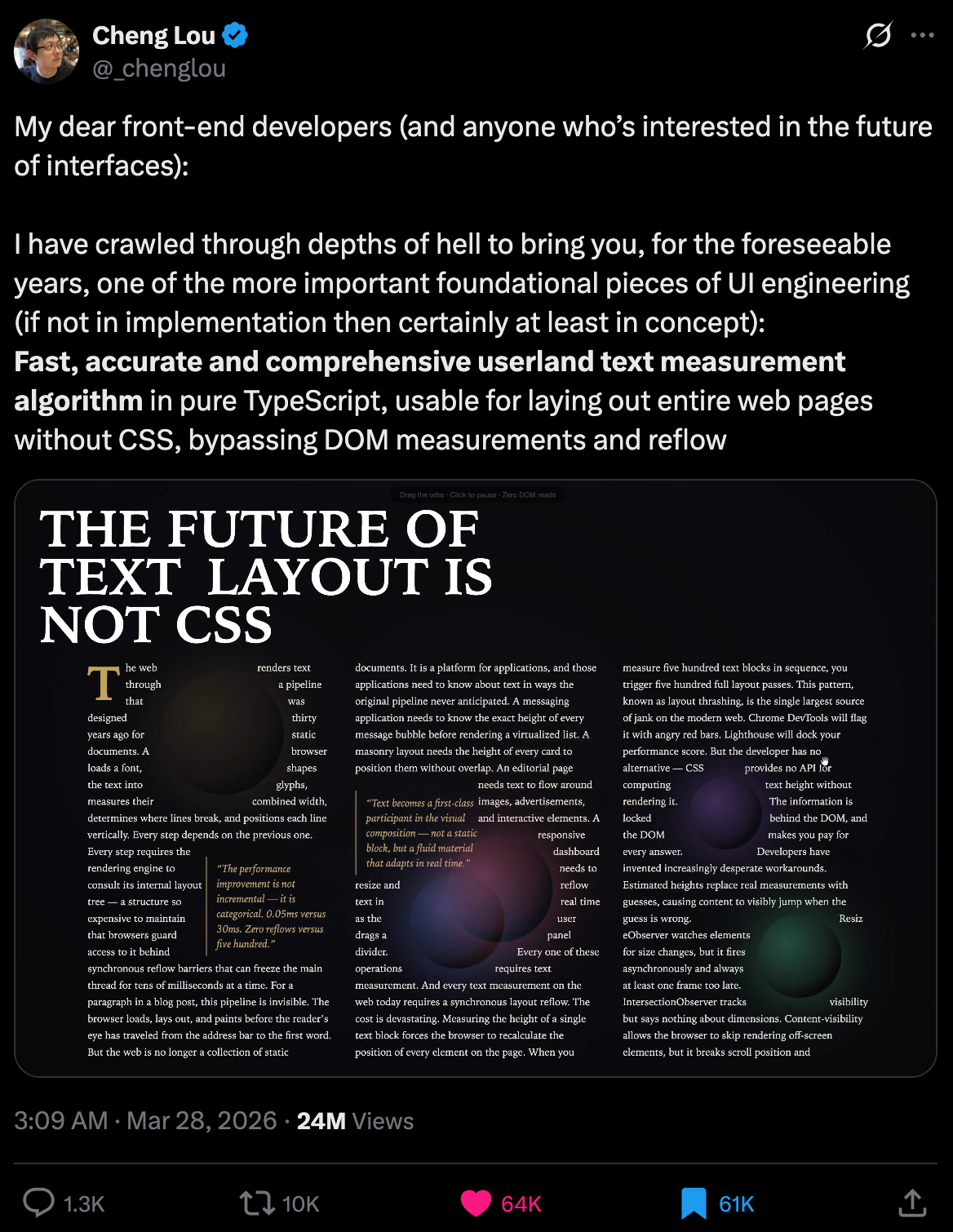
What's so revolutionary about this? Pretext solves the problem of calculating the height of a paragraph of line-wrapped text without touching the DOM. The usual way of doing this is to render the text and measure its dimensions, but this is extremely expensive. Specifically, every time you need to figure out how tall a paragraph is or where a line breaks, the DOM triggers a reflow — on mobile, a single forced reflow can block the main thread for about 10–100ms.
And because it's magnitudes faster than the previous DOM rendered approach, all text now becomes fully dynamic and interactive. Which is why we saw all the crazy demos pop up at the time. I also found this cool website that aggregates a bunch of the examples here:

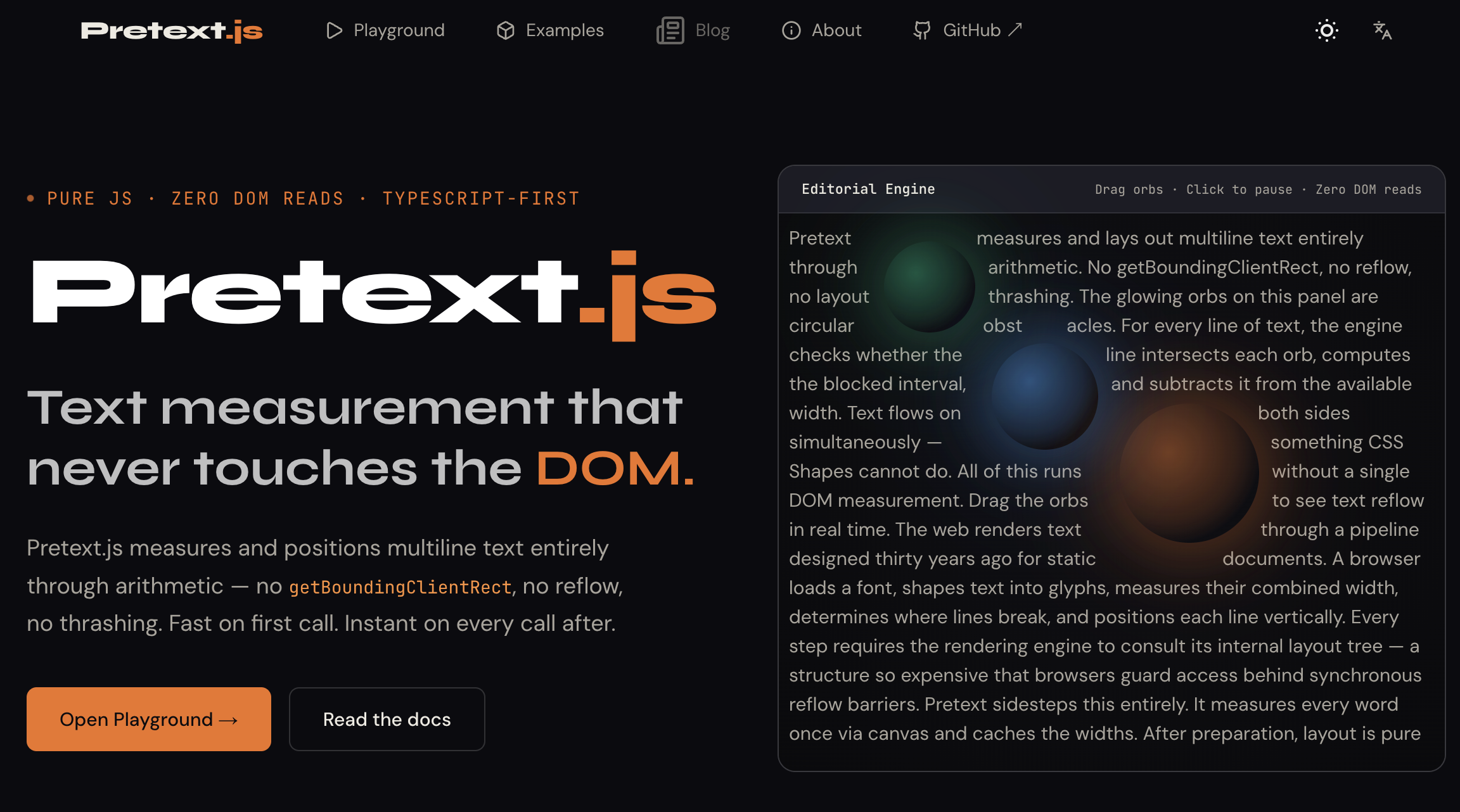
If you want to build something cool with it yourself, here's also the github repo.
 X
X
How does this work IRL? Essentially, you can now nest HTML elements inside of a canvas tag that's marked with the layoutsubtree attribute (either directly or programmatically). Then with the new ctx.drawElementImage(element, x, y) you actually draw the elements into the canvas. Lastly, the browser also needs to know where we drew it so it can route clicks and hovers to the right place, which is done by attaching the style transform returned from this function to the actual element.
If that's confusing, the official post above explains it much more clearly — there's also an in depth tutorial from frontendmasters here:
 Amit Sheen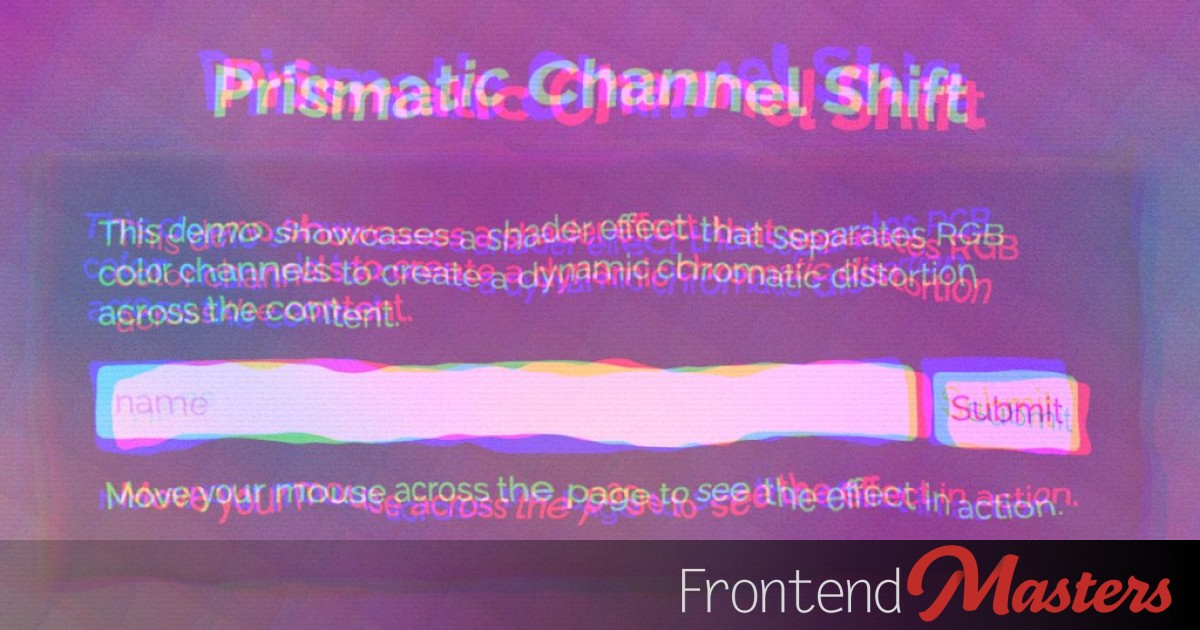
If you want to see some cool demos check out this showcase.

Obviously you could just write the Web Audio javascript code from scratch if you wanted to build something specific, but going through some of the examples that Heydon provides, makes it obvious that this layer of abstraction does lend itself to some creative affordances. Particularly coupled with browser events, like page scroll, mouseclicks, etc. I think there's a lot there. A different approach to
So the next time you want to incorporate some audio in a project of yours, consider using Hyperblam instead of the Web Audio API. As an aside, the website is also a work of art in of itself with the custom font and the hand-drawn illustrations.

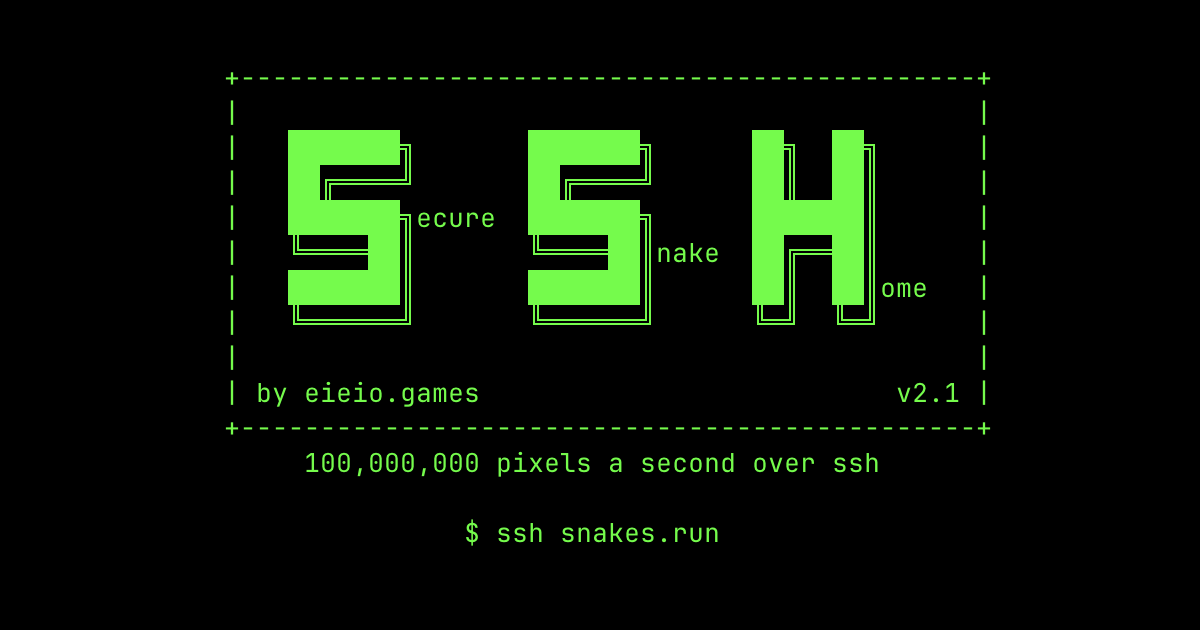
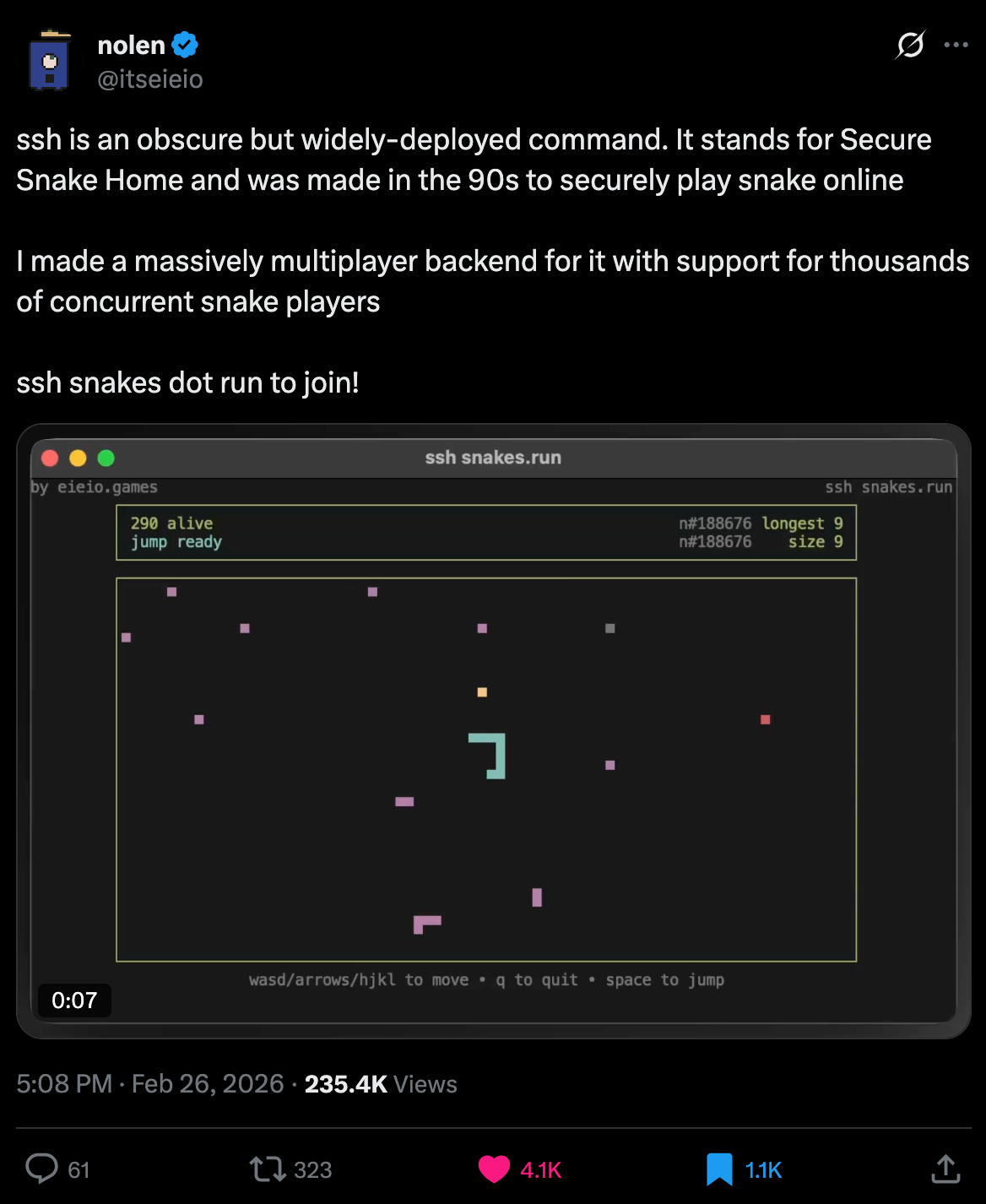
In his blog post, he explains how he overcomes some impressive, entirely self-imposed, engineering challenges to make it possible — including making the game aesthetically pleasing in the terminal, streaming it at a reasonable bandwidth, and making it performant enough to allow for 2500 concurrent players.

AI Corner
Coming back to compiling this newsletter, this section has only increased in relevancy. Considering the tech landscape, I'd argue it's probably the most important one at this point.
Will I change the order of the newsletter though? I would still like to keep the focus of this newsletter on human x code creativity — if something happens to use AI in the process then I'll still include it in the lead section, while this one is reserved for the discourse around AI as a whole.
A few years ago this part felt more of a "Hey, look, here's something cool happening in AI", now I feel that I should engage a lot more in the discourse overall. Especially seeing with how disruptive AI has been across many disciplines and fields.
The only way out for keeping my employability in the long-term now seems to be shifting my domain expertise to something LLMs will not get good at so easily. But what's left?
I couldn't track down who wrote it, but I've been sitting with the same question for months. What specific forms of human expertise — in writing and architecting code — are agents still genuinely bad at? Where does the hard ceiling actually sit? What are the skills that I should get really good at, that agents and LLMs still haven't cracked?

I hate fearmongering, hence I have a sense that we will eventually figure out something that AI is truly bad at and will never be able to solve; my hunch is that it has something to do with creativity and human connection.
For creative processes AI is largely a liability, where prompting something into existence just means having to clean up after it.

And I couldn't agree more. Similarly to before, I feel that typing prompts into an agent slowly erodes my reasoning and creative skills. This is why I try to limit my usage. It's very similar to doomscrolling on instagram and how it completely obliterates my ability to concentrate or keep my attention for longer than the duration of a reel.
 Tim
Tim
 [email protected]
Without learning any weights, he wants to see if the gzip algorithm can actually be used for text prediction, and it actually kinda works. "It’s not exactly coherent text, but it clearly knows something about the text. Much more than I expected gzip to know. So how can a compressor generate this?"


It has something to do with the fact that compression is inherently a form of probability modelling, but I'll leave you to discover this for yourself in the post.
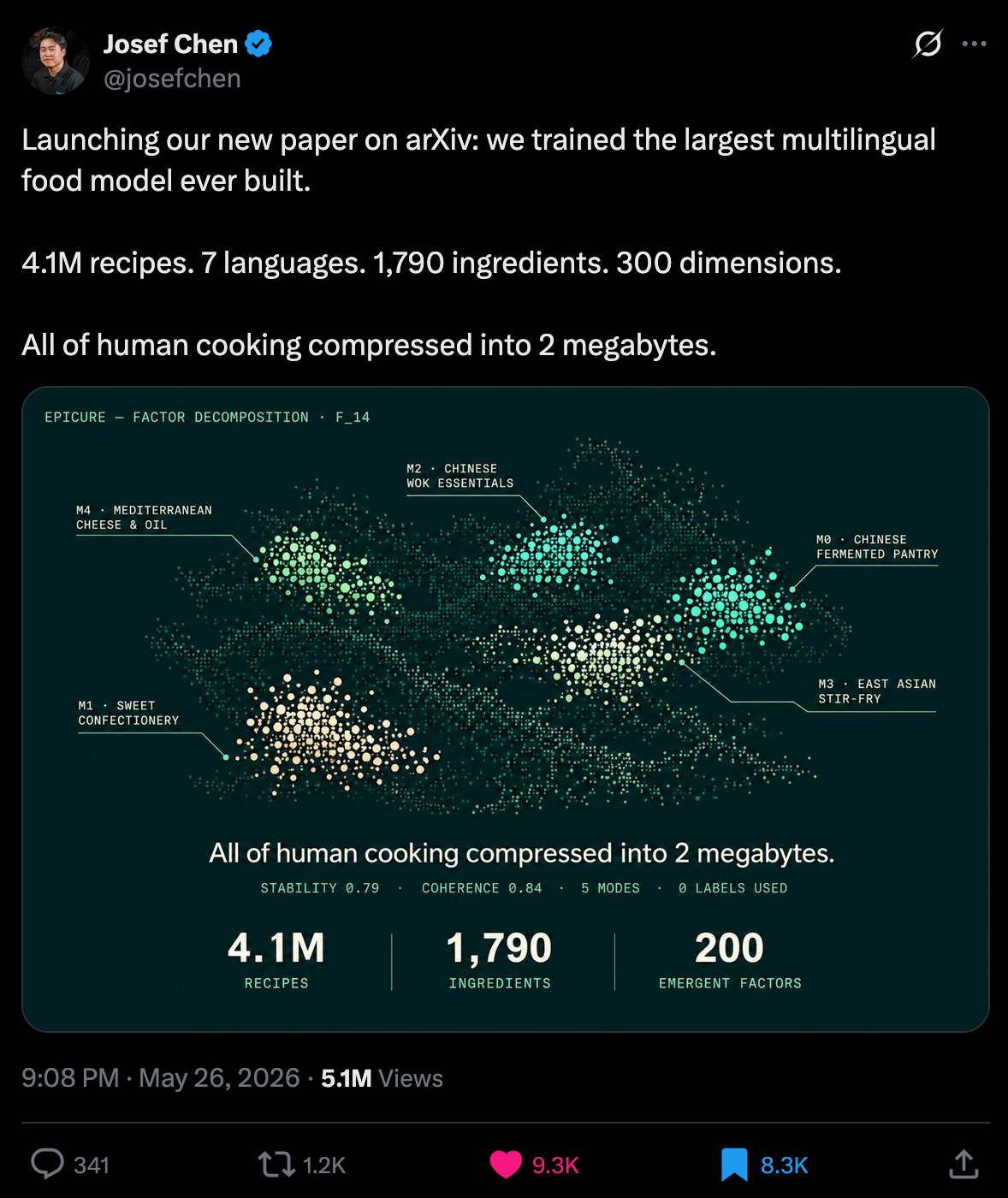
The full paper, Epicure: Navigating the Emergent Geometry of Food Ingredient Embeddings by Radzikowski & Chen (KAIKAKU.AI), is up on arXiv here. And you can play with a live demo here. Maybe the title might be a bit misleading though, but the demo clarifies it, essentially allowing you to compose recipes via a connectivity graph, that suggests what flavors go well together. This can then also be hooked up to an agent to give it knowledge about flavors and such.
Interesting discussion over on hackernews as always.
Devarsh Ranpara
Gorilla Updates
If you haven't read my update — here it is again:
 Ahmad Moussa
In the last few months I've tackled quite a few things — a big one was organizing all of my digital clutter, sifting through all of the sketches that I've made over the past years. Only considering the past Genuarys, then that already adds up to a 150 individual pieces. Right after coming back from the hospital I got started on building a little archive page to showcase all of them:
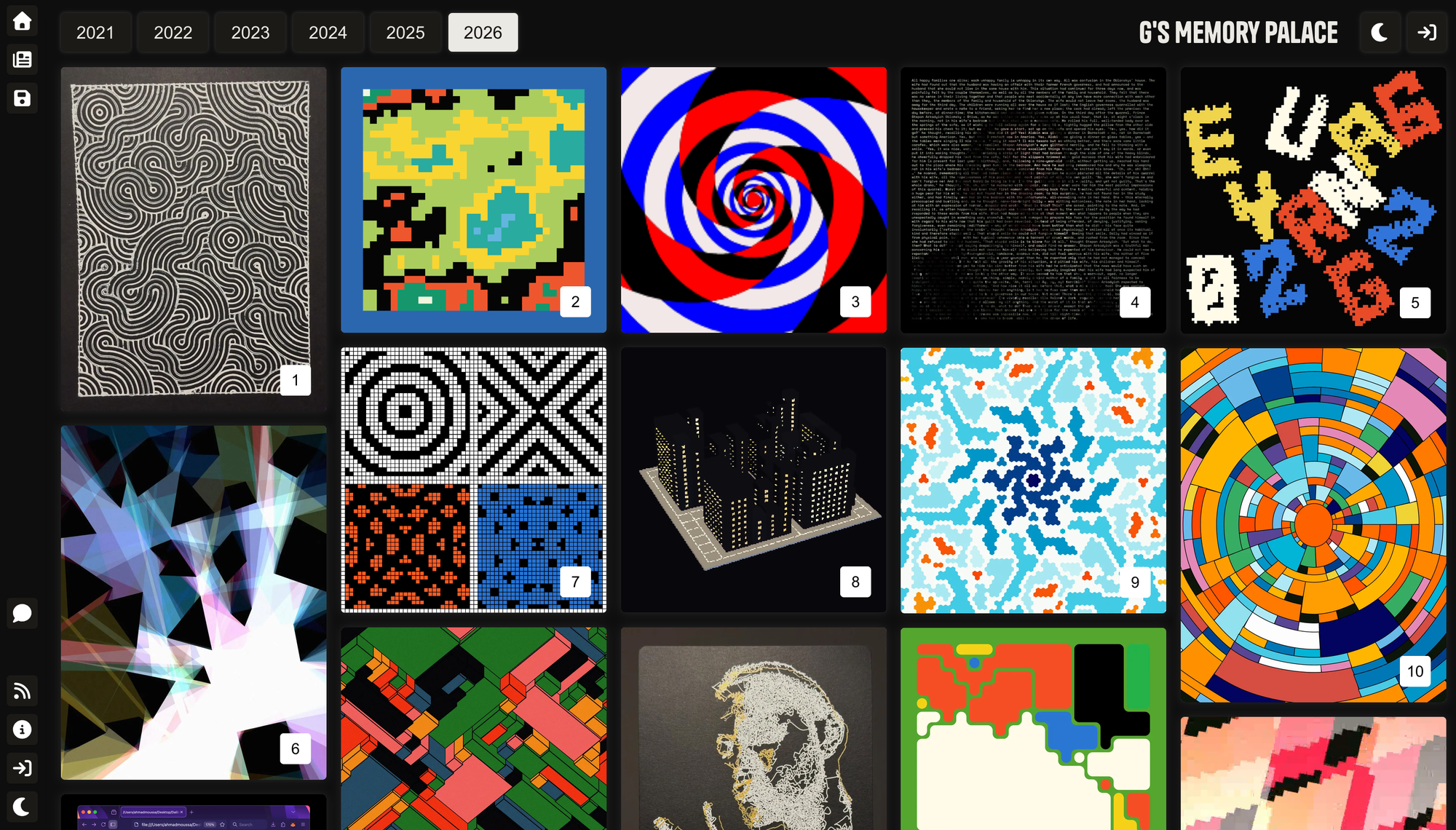
This ended up being a much larger endeavour than I had anticipated (story of my life). Since I want this archive to be clean, it required not just collecting all of the projects from my hard drives — I really have not done a good job organizing my folders in the past — setting up a database to store the images for each one, writing an individual description for each, and hardest of all, cleaning up the code as well. There's still a lot to do there tbh, but it's an enjoyable process to which I can allocate a little bit of time when I don't feel like doing other tasks.
This involved learning lots about react and Next.js, and there's much to share there, but I'll probably keep for that for a future update!
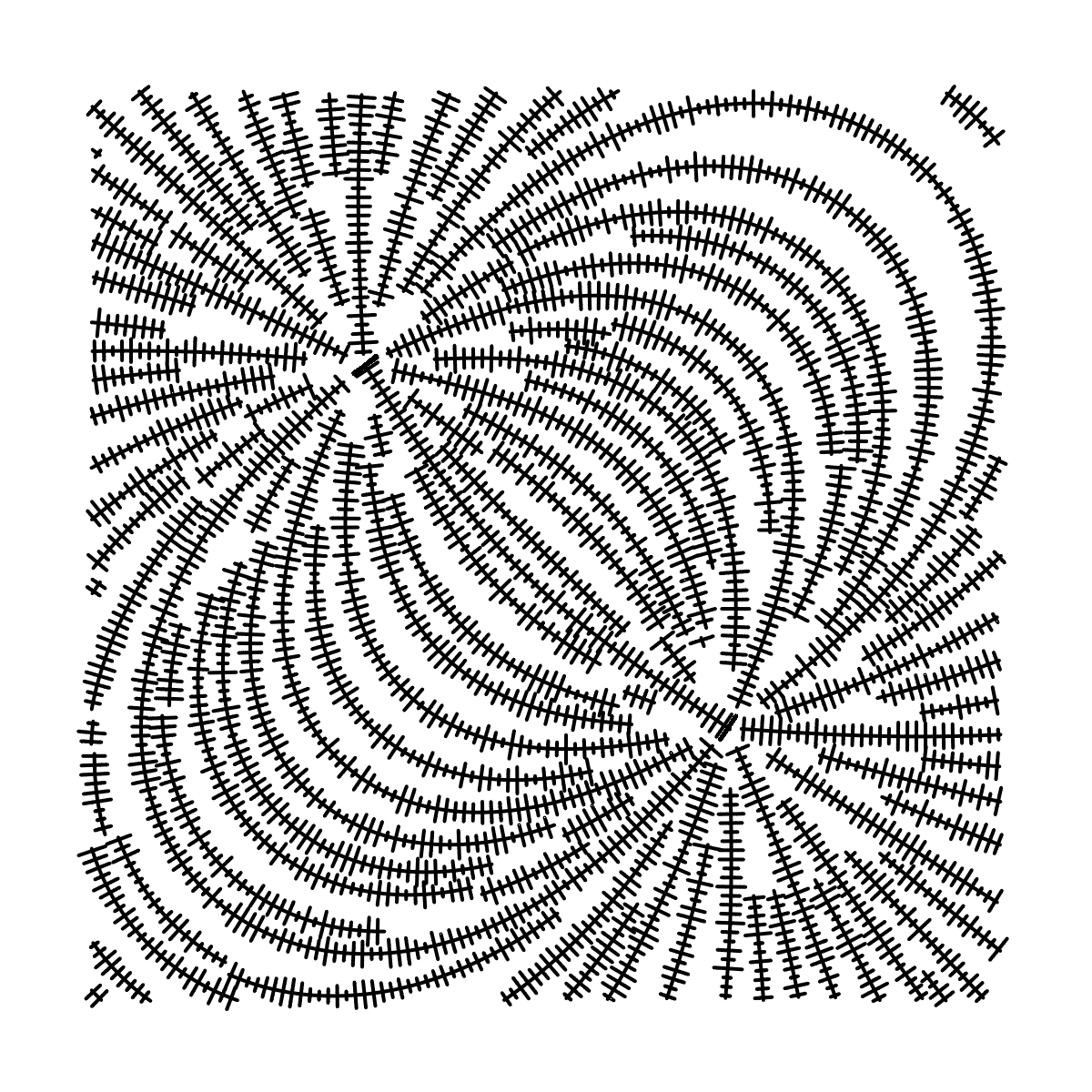
Besides that I also went back to playing with flow-fields — the highly, highly overdone shtick in genart. I recently went back to look at Junia Farquhar's Dipolar, an Art Blocks project back from 2022. I was always very impressed with the compositions, and the incredibly satisfying manner in which the flow field wraps around the magnetic poles placed on the canvas.
Hence why I made the attempt to implement my own version. The math is fairly easy to get something rudimentary going, but it ends being quite slow with how many computations it takes to determine how the flow lines should bend. I got it somewhat speedy on CPU, but still not fast enough to really call it "real-time".
I might write something about this eventually, I think it's interesting enough.
Music for Coding
In an ever-growing catalogue of AI generated playlists, I am in a constant search of original human-made music. Skee Mask blends ethereal textures in a way that's reminiscent of Aphex Twin — highly enjoyable, and highly recommend letting yourself sink into this album:
And that's a wrap — hope you've enjoyed this curated assortment of tech shenanigans! I'm really happy to be back. I'm not yet sure if this is going to be a weekly thing again or not, or if I have the stamina to send it out on a very consistent basis — but I'll give it my best shot.
Now that you find yourself at the end of this Newsletter, consider forwarding it to some of your friends, or sharing it on the world wide webs—more subscribers means that I get more internet points, which in turn allows me to do more internet things!
Otherwise come and say hi over on TwiX, Mastodon, or Bluesky and since we've also got a Discord now, let me plug it here again. It's been a tad bit inactive, but we can change that... maybe.
If you've read this far, thanks a million! And in case you're still hungry for more generative art things, you can find a backlog of all previous issues here:

Cheers, happy coding, and again, hope that you have a fantastic week! See you in the next one!
~ Gorilla Sun 🌸